
About My Sound
Designing, building, and growing a website platform for independent musicians.
- Product strategy, UX research, Product design, UI design, Product engineering
- 20% → 60%
- 8
The problem
Independent musicians know they need a professional website. It’s where fans find their music, promoters check their shows, and industry contacts look for a bio, press photos, and upcoming performances.
But most musicians aren’t web designers, and generic website builders hand them a blank canvas.
That leaves an artist facing questions they aren’t necessarily equipped to answer: what belongs on my site? How should it be organized? What does a professional artist site actually look like?
The result is websites that go unfinished, become outdated, or never get started in the first place.
We saw an opportunity to build something specifically for musicians.
The approach: freedom through constraints
We made an early decision not to build another general-purpose website builder with hundreds of options.
Instead, About My Sound starts with the sections an artist website actually needs: music, releases, shows, photos, videos, bio, contact information, and mailing lists. Artists can reorder, hide, and edit them, but they never start from nothing.
This was a deliberate tradeoff. Constraints meant saying no to features some users might want. In exchange, a first-time user gets a strong starting point, while an experienced artist still has enough control to make the site their own.
That principle became a tiebreaker for product decisions throughout development:
If a feature adds flexibility at the cost of clarity, it doesn’t ship.
Organizing the product around how musicians think
Artists don’t think in terms of navigation, content models, or components. They think: my music. My shows. My photos. My story.
So we organized the product around those same concepts.
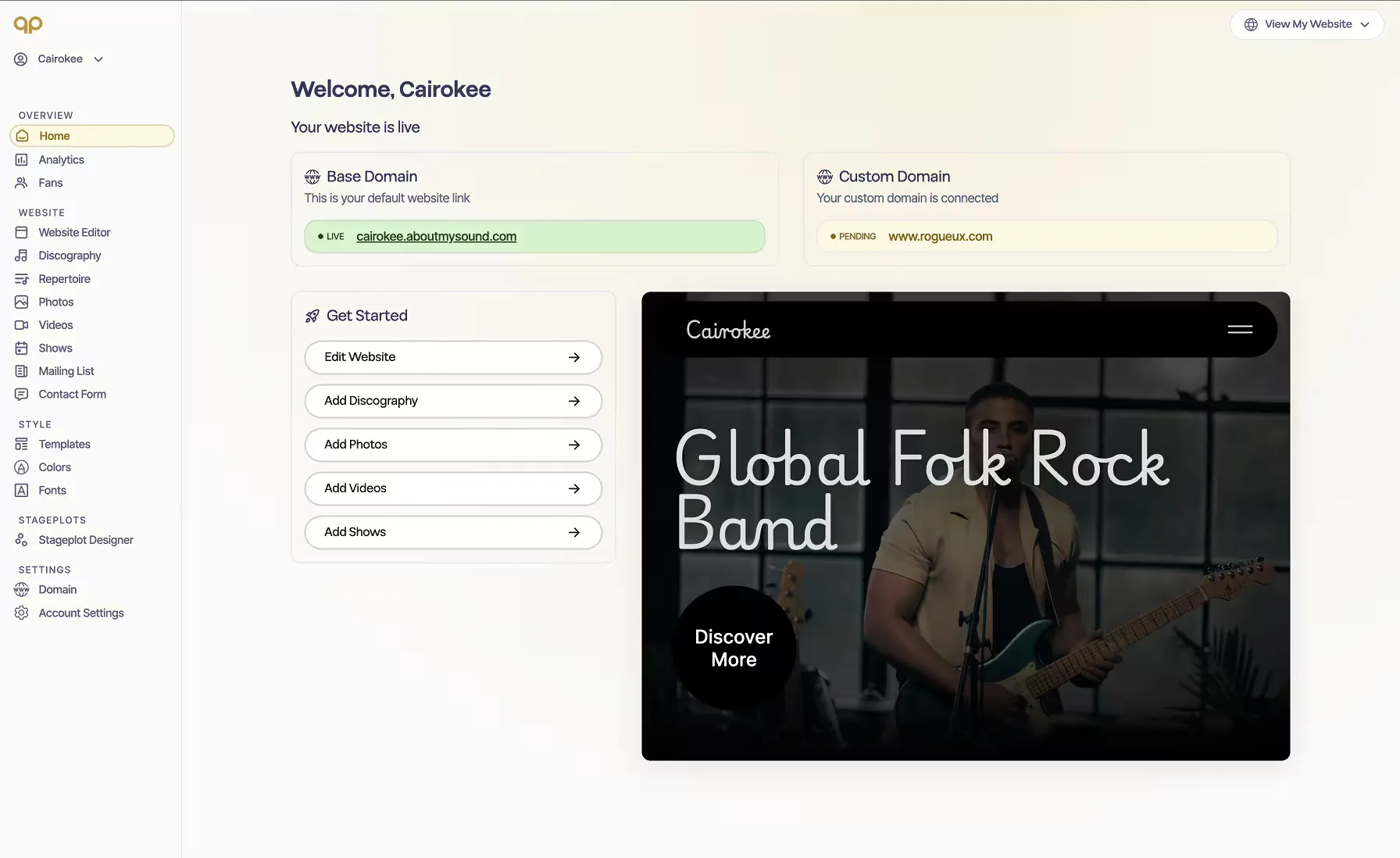
Instead of assembling pages from generic blocks, artists get dedicated tools for managing each part of their online presence, including discography, shows and ticket links, photos, videos, mailing lists, contact forms, downloadable press kits, and stage plots.
Changes made in the dashboard flow directly through to the public website, turning the site into a living source of truth rather than a brochure that gradually goes out of date.
Fixing onboarding: from 20% to 60% completion
Our original onboarding had a problem: only about one in five new users finished setting up their site.
To understand why, we combined session recordings in Microsoft Clarity with interviews with musicians who had signed up but not completed setup. The research helped us identify where users were getting stuck and which decisions were creating unnecessary friction.
We rebuilt onboarding around one goal: get the artist to a finished, live website as quickly as possible.
The new flow reduced setup to a small number of meaningful decisions:
Create your profile → Choose a template → Choose your visual direction → Add your content → Go live
The product handles the structural decisions automatically, while artists provide the information only they can provide.
Onboarding completion increased from roughly 20% to 60%.
A template system that doesn’t flatten individuality
The risk of a structured product is that every site starts to look the same. The risk of a highly flexible product is that it becomes difficult to use.
We addressed this with a system of eight templates, each with a distinct visual direction while sharing a common content model underneath.
Artists can change imagery, colours, typography, and content, and switch templates without rebuilding their site. That means a folk duo and a metal band can use the same platform without their websites feeling interchangeable.
Growth through a small, useful tool
The stage plot generator started as a simple utility: a quick way for bands to create the diagrams venues often request.
It turned out to solve a real search-driven problem for musicians and became a significant source of organic traffic to the product.
That changed how we thought about growth. Rather than relying entirely on traditional content marketing, we began looking for small, genuinely useful tools that solve specific problems for musicians and create a natural path into the broader product.
Built as one system
We designed and engineered About My Sound end to end, with product design and implementation happening together rather than as separate phases.
- Webflow powers the dashboard interface and design system.
- Cloudflare Pages and Workers serve artist websites and handle frontend logic, including custom artist URLs.
- Xano powers the backend and API.
- Stripe handles subscriptions and billing.
Owning the whole stack means we can move quickly from research finding to product change — which was particularly important when iterating on onboarding.
Results
- A live product with paying customers across independent artists and bands
- 3× increase in onboarding completion, from roughly 20% to 60%
- An eight-template design system built on a shared content model
- A stage plot generator that became a significant organic acquisition channel
- A product architecture designed to support websites, press kits, fan tools, and artist resources in one platform
See it live: aboutmysound.com